

Building in Japan from outside it
Japanese construction capability is among the hardest in the world for an international client to reach, because almost nothing about it is arranged for someone arriving from outside. We make it reachable. These are the questions we are asked first.
A foreign company can build in Japan. There is no nationality restriction on owning land or commissioning a building, and no requirement for a Japanese partner to hold the asset. The practical obstacles are three: the market runs on established relationships, documentation and approvals are in Japanese, and a design produced abroad needs work before it satisfies Japanese code. Hiterra holds the construction contract, carries the design through code and certification, and builds it.
Can a foreign company build in Japan?
Yes. There is no nationality restriction on owning land or commissioning a building in Japan, and no requirement for a Japanese partner to hold the asset. What makes it hard is practical: the market runs on established relationships, documentation and approvals run in Japanese, and a design produced abroad needs work before it satisfies Japanese code. All three are solvable, and solving them is our job.
Why will Japanese contractors not quote my enquiry?
It is a question of how the market is built, not who is asking. A Japanese contractor works inside a system of established relationships, standard documentation and shared assumptions about how a project runs. A foreign enquiry sits outside all three. It arrives in the wrong format, from an unknown party, with a design produced to another country's code, and often with contract terms the contractor has no precedent for. The cost of pricing that enquiry is high and the probability of it converting is low, so it is declined without explanation.
Who holds the contract when the client is overseas?
This is the question that stops most projects before they begin. Construction work in Japan is contracted by a licensed party, and the client needs a counterparty who will sign with a foreign entity and carry responsibility for delivery. We hold that contract. The client contracts with one party, that party carries the Japanese side, and the client is not left assembling a chain of local subcontractors in a language and procurement culture they do not know.
Will my architect's design work under Japanese code?
Not without work. A design produced outside Japan arrives as architectural intent, not as a compliant building. Structural conventions differ, seismic requirements are more demanding than in most markets, and fire treatment and certification routes for materials are specific to Japan. The Oman Pavilion at Expo 2025 is a direct example: a timber building designed outside Japan, carried into Japanese structural and fire requirements without losing what the architect intended, and built to a fixed date.
How long do approvals and material certification take?
Approvals run to a schedule that is largely predictable. Material certification is where programmes are lost, because it is usually discovered late. On the Portugal Pavilion the specified cork lining was not a product. No manufacturer made it, so there was no catalogue entry, no lead time and no fire certificate, and in Japan an interior lining without certification cannot be installed. We routed raw cork to a manufacturer with material development capability, had it worked into a textile, treated it with fire retardant and took it through Japanese fire testing: three months from raw material to installed surface, six weeks of which was certification alone. Selecting a material before confirming its certification route is the most common cause of late interior specification change.
What does building in Japan cost a foreign client, and why?
Japanese construction is not cheap and should not be sold as such. Labour is scarce, standards are high and rework is rare because it is designed out rather than corrected on site. The cost that surprises foreign clients is not the tender price. It is the cost of the gaps: a certification route discovered three months late, a design revision that has to pass back through approval, an interface nobody owned. Those are avoidable, and avoiding them is most of what we do.
Seven governments, one opening morning
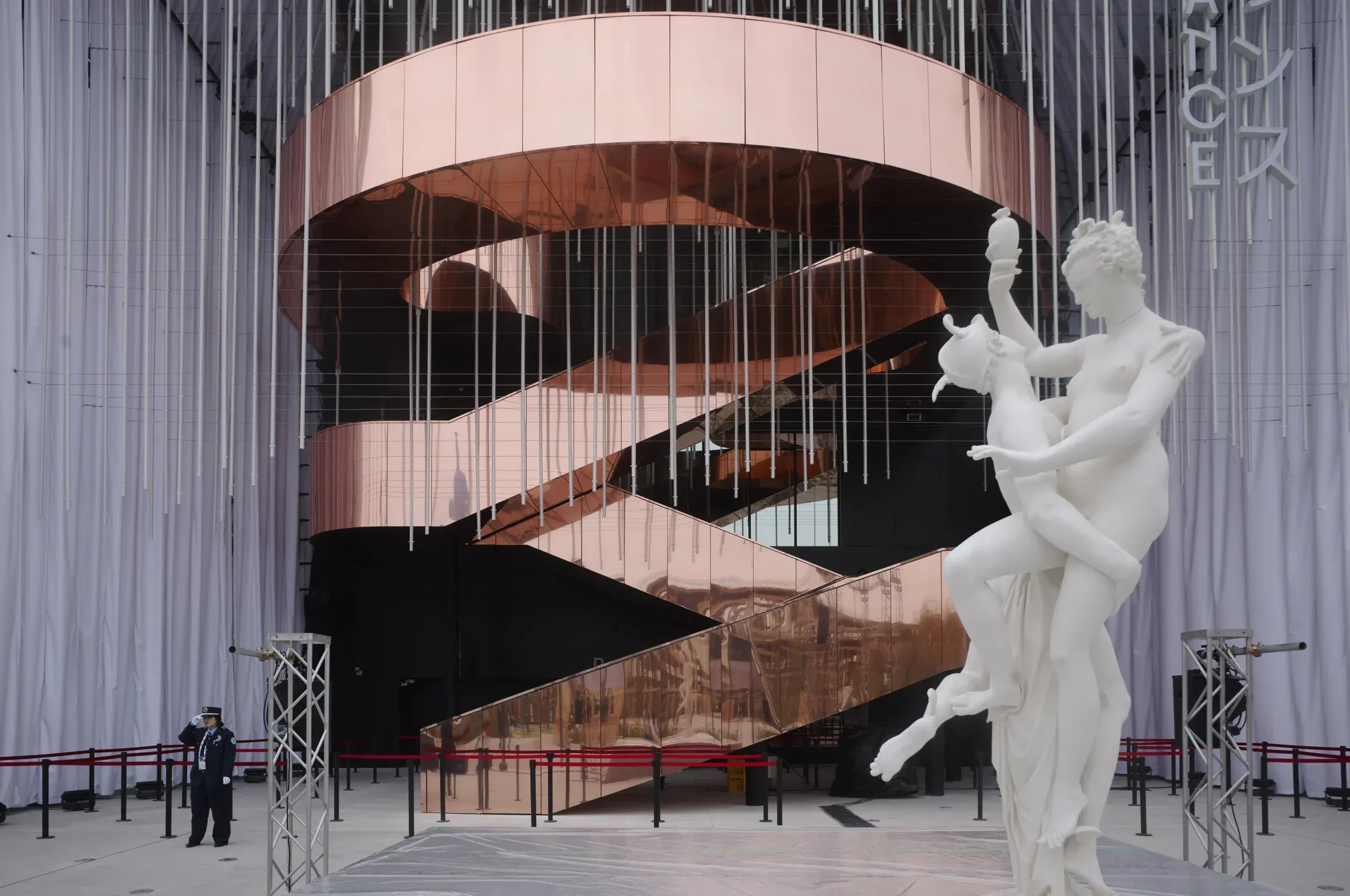
At Expo 2025 Osaka, seven participating governments each had to build in Japan. Each procured separately, through a different main contractor, to a different architect's design, in a country none of them worked in. There was no extension available to anyone.
One procurement team ran across all seven. Every one of them opened on 13 April 2025.
It is the same problem any owner faces building here from outside: an unfamiliar market, a fixed date, and a design that was not drawn for Japanese code. We answered it seven times in one season.
Where this usually starts
Most projects reach us as a location, a building type and a date. That is enough for a first assessment of what will be hard about it. We answer within two working days.